
A brand can appear in an AI answer without receiving a link to its website. That was the clearest finding from our linen-sheet study in Cuebase.
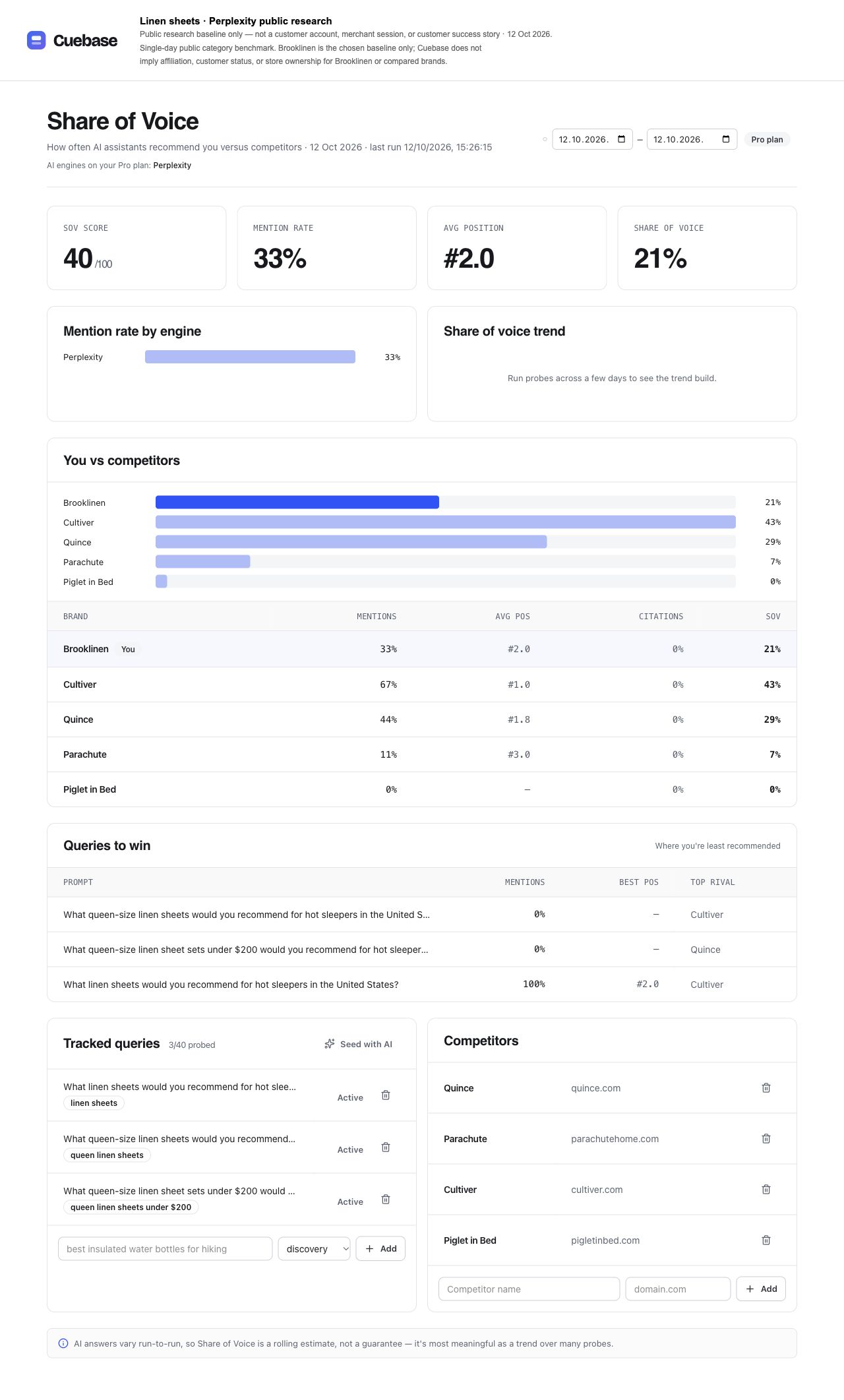
We ran three shopper questions three times through Cuebase’s Perplexity provider on 12 October 2026. Cultiver appeared in six of nine answers. Quince appeared in four. Yet none of the returned source URLs pointed to the five brand domains we tracked.
The practical lesson: check brand mentions and source links separately. A mention tells you that the answer named your brand. It does not tell you where a shopper could click.
The three questions we tested
- What linen sheets would you recommend for hot sleepers in the United States?
- What queen-size linen sheets would you recommend for hot sleepers in the United States?
- What queen-size linen sheet sets under $200 would you recommend for hot sleepers in the United States?
Each question received three responses. All nine requests completed without a provider error. We kept the wording fixed across repeats and changed only the size and budget constraints between questions.
This is a public category study, not a customer result. We chose Brooklinen as the research baseline, with Quince, Parachute, Cultiver, and Piglet in Bed as comparisons. Their inclusion does not imply ownership, sponsorship, endorsement, or a Cuebase customer relationship.
Who appeared in the answers?
| Tracked brand | Answers naming it | Answers with its tracked domain in the source list |
|---|---|---|
| Cultiver | 6 of 9 | 0 of 9 |
| Quince | 4 of 9 | 0 of 9 |
| Brooklinen | 3 of 9 | 0 of 9 |
| Parachute | 1 of 9 | 0 of 9 |
| Piglet in Bed | 0 of 9 | 0 of 9 |
The denominator is nine completed answers. We count a brand once per answer, even when its name appears twice. An answer can name several brands, so the rows add up to more than nine.
Cultiver appeared in all three general answers and all three queen-size answers. Quince appeared in all three answers to the under-$200 question, plus one general answer. Brooklinen appeared in the three general answers and none of the size- or budget-specific answers.
Those are patterns in this small capture. They do not establish a stable ranking or explain why a brand appeared. The answers also named brands outside our five-brand comparison set.
Where did the source links go?
The nine responses supplied 90 source entries: 23 distinct URLs across 13 hostnames. These were publisher or organization sites, rather than brand storefronts or forums. Returned source lists can include entries without an inline citation marker, so 90 is a count of supplied entries, not 90 verified claims.
| Returned source hostname | Responses containing it |
|---|---|
| nytimes.com, forbes.com, hgtv.com | 9 of 9 each |
| businessinsider.com, shopping.yahoo.com, architecturaldigest.com, wired.com | 6 of 9 each |
| apartmenttherapy.com | 5 of 9 |
| bhg.com, cnn.com, ncoa.org, thegoodtrade.com, cnet.com | 3 of 9 each |
We count each hostname once per response. Several Wirecutter pages in one answer still count as one nytimes.com appearance. NCOA is an organization publishing buying advice; the other hostnames belong to publishers.
One supplied nytimes.com URL was an outbound deal link with an Amazon merchant parameter. We classified the returned hostname, without following the redirect. A publisher source might also contain shopping links on its own page. Neither case is a direct brand-domain URL in the captured answer.
For a merchant, this changes the next question. Ask which pages the answer supplied as sources, then inspect whether those pages describe your product accurately. A brand mention alone cannot answer that.
The budget answers need a product-fact check
The three budget answers did not describe Target’s entry consistently. One named a Casaluna 100% linen set. Another called it a Casaluna linen blend. The third named a Threshold 100% linen set.
We have not verified those product identities or prices. The differences are a reason to check the listing, not evidence that any of the three descriptions is correct.
Keep measurable product facts separate from comfort claims. Fiber composition, included pieces, size, and pocket depth belong on a fact checklist. An answer’s claim about cooling or sleep quality is not a product test. Do not copy it into your catalog as proof.
Repeat the check for your store in Cuebase
- Choose a small question set. Start with a broad product question, then add a size, compatibility, or budget requirement. Our shopping-question worksheet helps you keep the wording fixed.
- Run the questions in Share of Voice. Use Run probe now, then review the brand table and Queries to win. Compare the same engine and date range each time.
- Save the baseline. Use Export CSV for Cuebase’s recorded metrics. Keep any answer text and source URLs you review in a separate research log; the export is not a full source-by-source audit.
- Check one useful gap. If a size-specific question omits your brand, inspect the relevant product’s dimensions and variant information. Correct a documented omission, record the edit date, then repeat the same questions. Do not assume the edit caused any later change in answers.
Method, limits, and downloads
We used Cuebase’s live DataForSEO provider, probe runner, brand detector, and summary code with isolated research storage. The engine was Perplexity, the returned model was sonar, and web search was requested. Requests used a 400-token output cap. One saved response ends mid-sentence, which limits what it can show.
These were API responses, not recordings of the consumer Perplexity website. All nine were captured within seconds on one day. Similar repeated answers should not be treated as nine independent measurements of long-term visibility. We separately read the saved source annotations for the hostname table.
The study measures returned names and links. It does not measure clicks, sales, search demand, product quality, or the effect of a catalog change. For metric definitions, read our AI share-of-voice guide.
- Download the 90-entry source log (CSV).
- Download the nine answers and study method (JSON). Product statements in the answers are unverified model output.
- DataForSEO’s Perplexity response documentation describes the API used. Source URLs and capture times are included in the downloads.
Start with three questions about your own products. Record who appears, which domains receive links, and which claims need checking before you change a product page.