
Start with the denominator
We ran three fixed shopping questions through Cuebase’s Perplexity probe, three times each. The questions covered everyday ceramic dinnerware, dishwasher-safe dinnerware, and a set for four people. All nine requests completed across 13 and 14 October 2026.
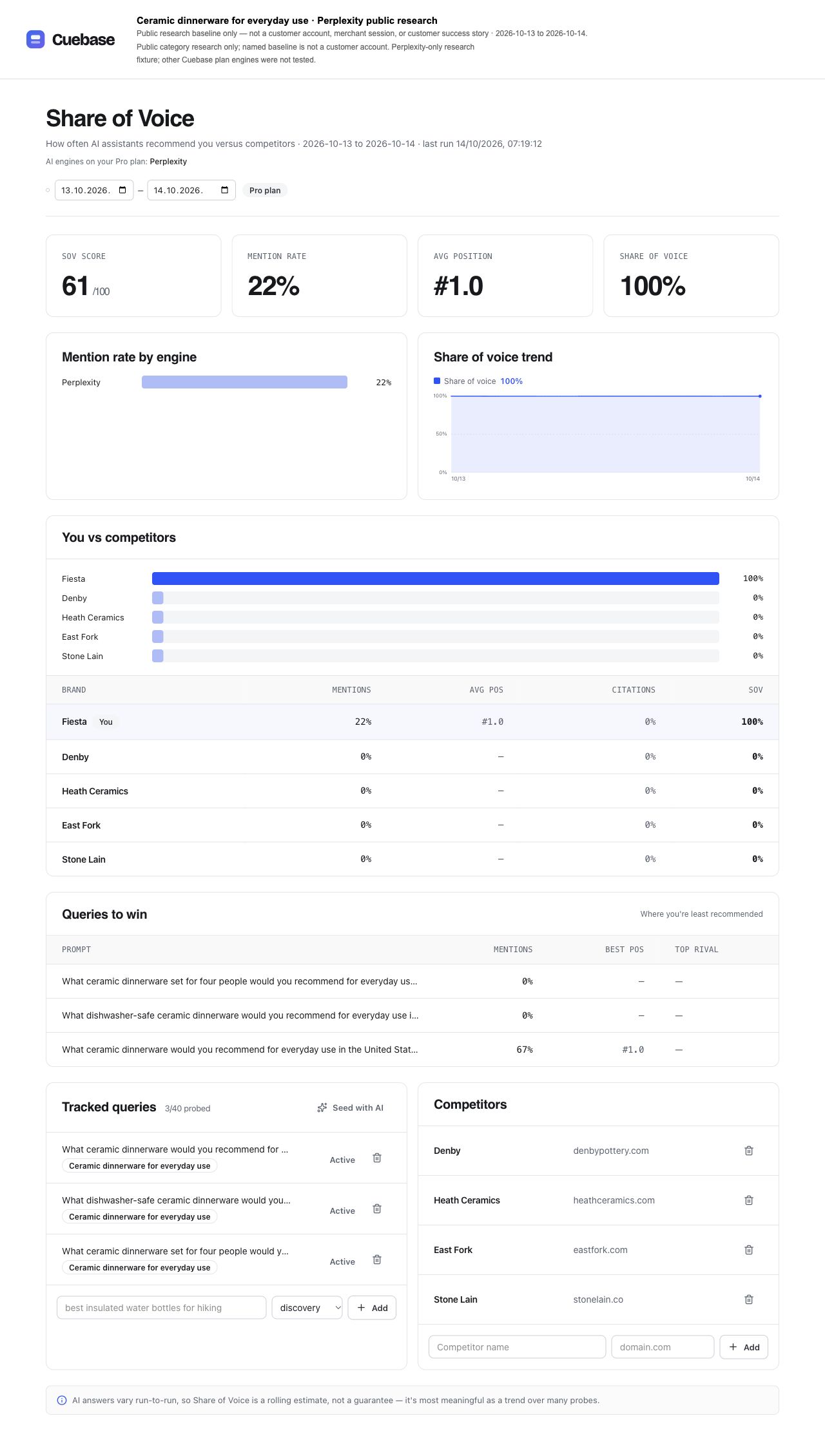
For the report, we tracked five names: Fiesta, Denby, Heath Ceramics, East Fork, and Stone Lain. Fiesta was a research baseline only; no merchant data or customer account was used. The automatic detector recorded the exact name Fiesta in two of nine answers; the other four tracked names did not appear.
A manual read found Fiestaware in two additional dishwasher-safe answers. We did not merge that variant into the saved report after the fact. The naming mismatch is useful: a tracked-name result can undercount a brand family when shoppers or models use another name.
That gives Fiesta 100% share of voice in the report because there were only two exact tracked-brand appearances. It does not mean Fiesta or Fiestaware received every recommendation, ranked first among all dinnerware brands, or outperformed the names we did not track.
What the answers positively proposed
We counted a name only when the answer proposed it for the shopper’s task. A source annotation alone did not count. Each named product or brand counts once per answer. Repeated mentions within an answer do not add to its count.
| Fixed prompt | Completed answers | Positive recommendation appearances | Requirement check and unknowns |
|---|---|---|---|
| Everyday ceramic dinnerware | 3 | 17 | Corelle, Fable, Wedgwood White, Our Place, IKEA and Fiesta appeared. Corelle is glass, not ceramic, so it does not meet the ceramic requirement. |
| Dishwasher-safe ceramic dinnerware | 3 | 16 | HF Coors and Gibson Home have official dishwasher-safe support; KooK claims remain unverified. Corelle is glass, and Fiestaware is a separate manual name variant. |
| A ceramic set for four | 3 | 3 | Year & Day Core Set appeared each time. Its exact configuration and care claims remain unknown in this review. |
Those prompt totals add up to 36 recommendation appearances across nine answers, not 36 unique products.
The set-for-four result is the clearest warning against treating repetition as proof. Year & Day appeared in all three answers, but we did not locate a current official product page that verified the answer’s exact 16-piece configuration or care claims. We record it as a recurring model recommendation, not a verified buying recommendation.
On 14 October 2026, we checked official manufacturer pages for facts used here. HF Coors lists its American White 12-piece set with four dinner plates, four dessert plates, and four cereal bowls, plus dishwasher, microwave, oven, broiler, and freezer care. Gibson Home lists the Hazeltine 16-piece stoneware set as dishwasher- and microwave-safe. Fiesta’s dinnerware FAQ lists its dinnerware as fully vitrified, dishwasher-safe, microwave-safe, and lead safe. Corelle’s FAQ identifies Vitrelle as glass, not ceramic. Exact care and availability still belong on the specific product page a shopper can buy.
Zero automated citations did not mean zero sources
The report recorded zero tracked-domain citations for every one of the five fixed brands. A separate manual check also found no match between the 90 saved source URLs and those tracked root domains or their subdomains.
Each response did contain ten section-level source annotations: 90 entries, 23 distinct URLs, and 19 exact hostnames. By response presence, Bon Appétit and The New York Times appeared in nine of nine answers; Forbes appeared in seven, Wayfair in six, and Amazon in three. These are returned source lists, not endorsements of every statement in the answers. A retailer or publisher URL is also not a product recommendation.
Separately, the automated citation arrays were empty because this provider placed the saved URLs in section-level annotations rather than the item-level citation field. The separate research harness reads and preserves those annotations in the source log. A normal Cuebase Export CSV is a metrics export; it does not export raw answer text or a source-by-source annotation record. For a merchant, inspect the answer and source list together. Do not infer “no sources” from a zero tracked-domain citation rate.
Run the same check for your catalog
Use fixed shopper questions
In Share of Voice, enter a broad question, a requirement question, and a specific buying question. Add only the competitor names and domains you want to measure.
Run and save the recorded result
Choose Run probe now. Then use Export CSV for Cuebase’s recorded metrics. Keep answer text and returned URLs in a separate research log when you need a source-level review.
Check product claims before changing a page
Use a recurring recommendation to choose what to inspect: material, care, included pieces, size, price, and availability. Verify those details on the product record. Do not copy an AI answer into a catalog as evidence.
Compare later runs carefully
Run the same questions again and record the date, engine, fixed tracked set, and source URLs. A later change can be worth investigating; it does not prove that an edit caused the change.
Method, limits, and downloads
These were Perplexity sonar responses from the DataForSEO AI Optimization LLM Responses API, run through Cuebase’s real provider and probe workflow with isolated research storage. They are not consumer Perplexity searches. Web search was requested, the output cap was 400 tokens, and the U.S. market was written into each prompt; no provider geolocation was configured.
We tested one engine, nine responses, two dates, and a fixed five-brand report set. The study does not measure clicks, orders, demand, product quality, or the effect of a catalog change. A 400-token cap can truncate an answer. Source annotations and automated citation fields are different data paths, so the download preserves the source annotations separately.
- Download the prompt-level findings (CSV).
- Download the nine saved answers, method, and source annotations (JSON).
- Download the 90-entry source log (CSV).
- Read DataForSEO’s Perplexity response documentation.
Use the report to find a claim to verify, then use the product record to make it true. See Cuebase’s paid AI visibility tracking →