
We asked the same three shopping questions three times each through Cuebase, then checked the model names against primary product sources. The answers supplied 10 named-product proposals across nine brand-answer proposals. They did not supply enough evidence to call any lamp a universal fit.
That distinction matters when you sell a compact product. A shopper asking for a “small desk lamp” is also asking about edge thickness, room beneath the edge, what arrives in the box and whether the price condition still holds.
What appeared in the nine answers
We counted a named model once per answer when the answer positively proposed it. An explicit alternative also counts. Names shown only as sources do not count. The q2 third answer proposed two IKEA models; that produces two named-product rows but one IKEA brand-answer appearance.
| Prompt | Positive proposals | What the count means |
|---|---|---|
| Small workspace | Voncerus LED Desk Lamp with Clamp: 3/3 | Three proposals, but no verified manufacturer record or fit specification. |
| 25 mm flat clamp edge | BenQ MindDuo AR19-D: 1/3; BenQ ScreenBar Max: 1/3; IKEA NÄVLINGE: 1/3; IKEA SKURUP alternative: 1/3 | Four named-product rows; BenQ appears in two answers and IKEA in one. |
| Under $60 | Globe Electric 32-inch clamp lamp: 3/3 | Three proposals. The saved responses did not verify a current US under-$60 offer. |
Across all prompts, that is 10 named-product proposals and 9 brand-answer proposals. These are response frequencies from a small, fixed sample. They are not product rankings, demand estimates or market share.
The clamp check is more than desk thickness
The clearest primary-source check was the BenQ ScreenBar Max. BenQ describes it as a desk-clamp lamp, not a monitor clip. Its specifications list a maximum desk thickness of 60 mm; BenQ’s installation guidance and base-accessory page give a 90 × 70 mm clamp footprint and 60 mm of needed underside clearance. A flat 25 mm edge passes the thickness condition. It still fails the test if the underside is blocked, the desk material is unsuitable or the clamp cannot sit where the lamp needs it.
The manufacturer specifications establish those conditions; they do not establish fit on every 80 × 50 cm desk. The MindDuo manual supports a 60 mm maximum clamp thickness, but its clamp inclusion depends on the purchased configuration and it does not give the clearance needed below the desk.
IKEA’s product pages list a 10–45 mm clamp range for both the NÄVLINGE and SKURUP. A 25 mm edge is within that range. Their available listings did not establish the rear or underside clearance, US availability or a current price.
Do not turn a retailer label into a product fact
The budget answers repeatedly named a Globe Electric 32-inch clamp lamp. Globe Electric’s own page identifies product 62000009 as a clamp lamp requiring one separate E26 bulb, up to 60 W. The returned answers also used Target listing ID 93095796 and model 56963. We could not match either identifier to Globe’s official product 62000009 page, so we kept that mismatch unresolved.
The official page uses Canadian pricing. It does not prove a current US price below $60. “Under $60” therefore remains a buying condition to check at the seller, not a claim from this study. One saved answer set the condition before tax and shipping; another included tax and shipping. Neither establishes a live US total. Voncerus was proposed in every general small-workspace answer, yet we could not find a verified manufacturer page for its exact model. Its clamp dimensions, ownership and clearance requirements remain unknown.
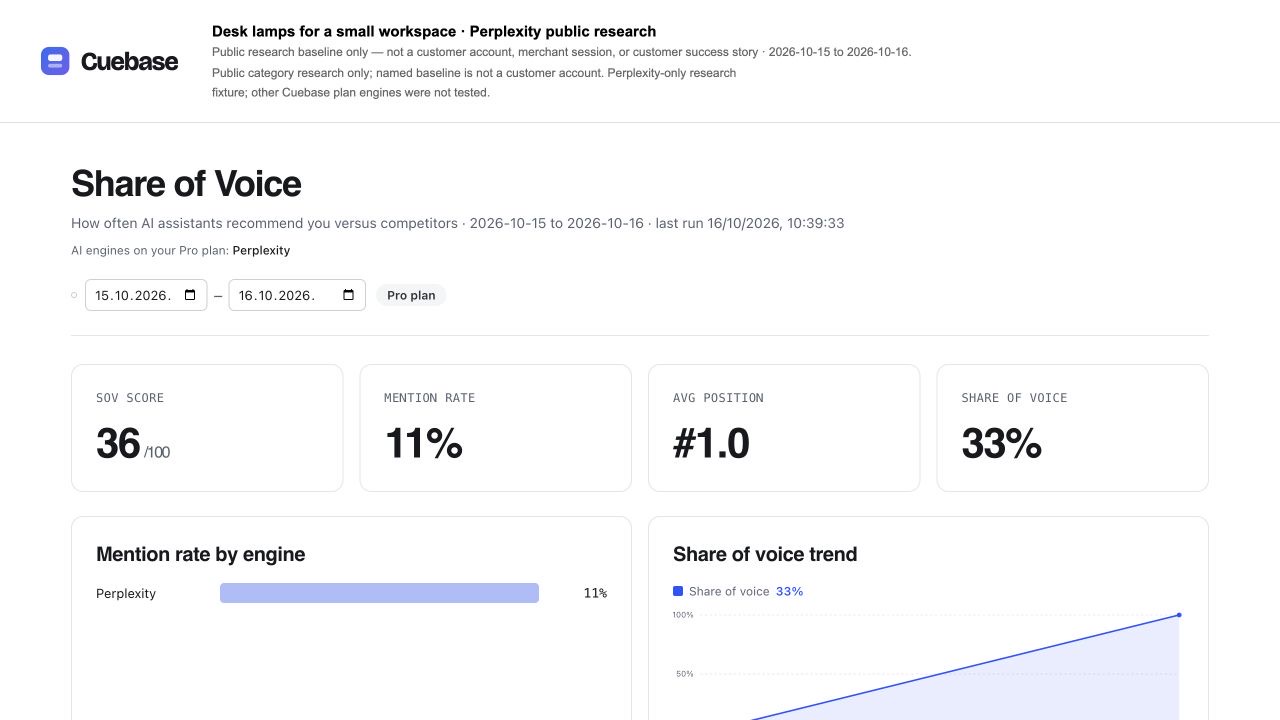
What the Cuebase report did and did not count
The saved Cuebase report tracked IKEA against BenQ, Anglepoise, TaoTronics and Neatfi. It detected IKEA in 1/9 probes and BenQ in 2/9, giving IKEA 1 of 3 tracked-brand appearances (33%). That is a comparison among five preselected brands, not all the products named in the answers.
Its automated tracked-domain citation rate for IKEA was 0%. Separately, the exported source log contains 90 source entries extracted from annotations (URLs deduplicated within each answer), representing 45 distinct URLs across 25 exact hostnames. A source annotation is not a product recommendation, and it is not the same thing as Cuebase’s automated citation field. Cuebase’s normal metrics CSV records probe results; it does not contain the raw answer text or a source-by-source verification log.
Use this workflow for your own product page
Write the constraint into the question
Ask for the exact model, desk thickness, mount type, clearance and price condition. For a clamp product, ask the assistant to leave an unverified dimension unknown.
Fix the comparison before measuring
In Cuebase Share of Voice, add the shopper questions and a fixed set of tracked brands. Choose Run probe now; keep that setup unchanged if you want a comparable next run.
Export metrics, then check the buying facts
Use Export CSV for mention, position and tracked-domain citation metrics. Keep original answers, annotations, product URLs and access dates in a separate evidence file. Do not let an answer’s retailer ID stand in for a manufacturer model.
Make the product page answer the missing check
Publish clamp range, footprint, underside clearance, material limits, exact variant and what is included. If a price is conditional, label the condition and update it at the retailer.
Method and limits
We made nine independent requests through Cuebase using Perplexity Sonar via the DataForSEO AI Optimization LLM Responses API: three fixed prompts, three passes each, captured on 15 and 16 October 2026. Web search was requested and each answer had a 400-token cap. No saved answer visibly cut off; the cap could still constrain what each answer covered. All nine completed; none failed. The prompts requested the United States, but no provider geolocation was configured. This was API research, not a consumer Perplexity or ChatGPT session.
It is a dated, small-sample snapshot. It does not test conversion, availability, product quality or why the model produced a name. No merchant account or customer data was used.
Download the original findings (CSV), dated answers and source annotations (JSON), and the source log (CSV). For the measurement definitions, read what to count, how AI share of voice works and your first baseline. See Cuebase’s paid AI visibility tracking →