
Read the prompts before the total
We ran three fixed U.S. shopping prompts through Cuebase’s Perplexity probe three times each: two runs on 14 October and one on 15 October 2026. All nine requests completed. We counted a product or brand once when an answer positively proposed it for the shopper’s task. A conditional proposal counts; a name in a source list does not.
| Fixed prompt | Answers | Positive proposal appearances | What needs checking |
|---|---|---|---|
| General commuting bag | 3 | 9 | Hydro Flask appeared in all three answers; PackIt in all three; L.L.Bean twice; Lifewit once. These are recurring names, not product rankings. |
| 20 × 14 × 7 cm container | 3 | 4 | Carhartt appeared twice, YETI once, and MIER once. The claimed usable interior dimensions for all three remain unconfirmed. |
| Wipe-clean lining and care | 3 | 5 | Lifewit, Tirrinia, Sistema, and Yumbox appeared. Sistema’s care sheet was the only full manufacturer care instruction set we confirmed. |
The rows add to 18 proposal appearances across nine answers. They do not mean 18 unique products, 18 recommendations from Cuebase, or 18 verified matches.
The report’s tracked-name result answers a narrower question
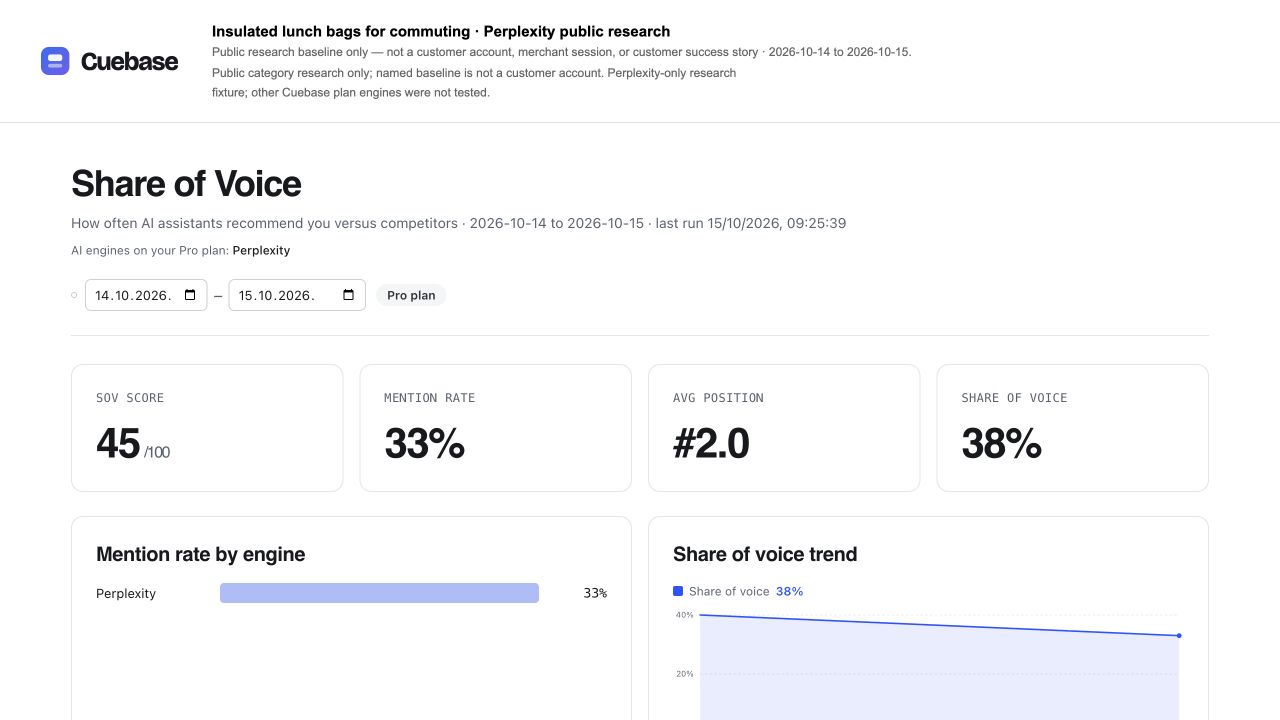
For the report, we fixed five names before running anything: PackIt, Hydro Flask, YETI, Bentgo, and Igloo. The automatic detector found PackIt in three of nine answers, Hydro Flask in three, YETI in two, and Bentgo and Igloo in none. No answer produced a matched tracked-domain citation.
That is useful only for those five exact names and these prompts. It is not a share of every product named in the answers. The manual proposal count is wider, because it also includes untracked names such as Carhartt, Sistema, and L.L.Bean. Keep those two measurements separate when you read a Share of Voice report.
Recurring does not mean verified
On 15 October 2026, Hydro Flask’s 5 L lunch bag page listed an 8.5 × 6 × 7.5 in inside dimension and a lined, insulated construction. L.L.Bean listed its Flip-Top Lunch Box as a 6 L insulated bag with an easy-clean lining. Those are facts about the named products, not proof that either is the best commuting bag.
The container prompt shows why this distinction matters. The answers repeatedly supplied 9 × 7 × 7 in as Carhartt’s usable compartment. Carhartt’s official page gives outside dimensions, not that usable measurement. We therefore record the fit as unknown. Do not copy a fit claim to a product page because it appeared twice.
For the care prompt, Sistema’s manufacturer care sheet says to hand-wipe with warm soapy water, avoid immersion, let the bag air-dry, and avoid a microwave, dishwasher, washing machine, and dryer. That supports the care instructions only. It does not prove a food-storage duration or a buying recommendation.
Use Cuebase to choose the next claim to inspect
Set three useful questions
In Share of Voice, add one broad shopper question, one requirement question, and one specific buying question. Add the competitor names and domains you want to measure before the run.
Keep the result tied to its denominator
Choose Run probe now, then read the brand and query results together. A named-brand rate applies to the tracked set; it is not a market-wide rank.
Inspect the product record
Use a repeated name to decide which product claim to check next: usable dimensions, lining, care, material, price, or availability. Confirm it on the current product record before changing catalog copy.
Export the metrics and save the evidence separately
Use Export CSV for Cuebase’s recorded metrics. This study’s answer text and section-level sources came from a separate research harness, because a normal metrics export is not a raw-answer archive.
Sources were present even though tracked-domain citations were zero
The nine answers contained 90 section-level source entries: 35 distinct URLs across 28 exact hosts. We counted those entries separately from recommendations. The automatic tracked-domain citation field was zero for all five names, and the source lists did not match their tracked domains. A source URL can support context without being a product proposal.
Method, limits, and downloads
These were Perplexity sonar responses from the DataForSEO AI Optimization LLM Responses API, run through Cuebase’s real provider and probe workflow with isolated research storage. They were not consumer Perplexity searches. Web search was requested, output was capped at 400 tokens, and the U.S. market was written into each prompt. No provider geolocation was configured. No merchant account or merchant data was used.
One engine, nine responses, two dates, and a fixed five-name report set cannot measure clicks, orders, product quality, demand, or the effect of a catalog change. The token cap can truncate a response. The saved section-level source annotations are separate from the provider’s automated citation fields.
- Download the prompt-level findings (CSV).
- Download the nine saved answers and method (JSON).
- Download the source log (CSV).
- Read DataForSEO’s Perplexity documentation.
Continue the workflow
- Learn what to count in an AI visibility report.
- Record your first AI visibility baseline.
- See how Cuebase measures AI share of voice.
Use the report to find a claim to verify, then make that claim true on the product record. See Cuebase’s paid AI visibility tracking →