
Three fixed questions across two dates
We ran three fixed UK shopping questions through Cuebase’s Perplexity probe three times each: a general induction-pan question, a 28 cm question that asked for the contact-base diameter, and a dishwasher-safe question. All nine requests completed across 14 and 15 October 2026.
What the answers positively proposed
We counted a named model or brand once per answer when the answer proposed it for the shopper’s task, including a conditional alternative. A source link alone did not count. A contextual comparison did not count: Miele appeared only to illustrate base dimensions.
| Fixed prompt | Completed answers | Positive proposals | What the count means |
|---|---|---|---|
| General nonstick pan for induction | 3 | 6 | ProCook appeared in all three answers; Blackmoor appeared in two; Eaziglide appeared in one. |
| 28 cm pan with contact-base diameter | 3 | 4 | Siemens appeared twice; Le Creuset and Tramontina once each. Miele was contextual only. |
| Dishwasher-safe pan for induction | 3 | 3 | Kuhn Rikon appeared twice; GreenPan Cambridge appeared once. |
The rows total 13 proposal appearances, not 13 unique pans and not 13 verified requirement matches.
What the fixed-brand report counted
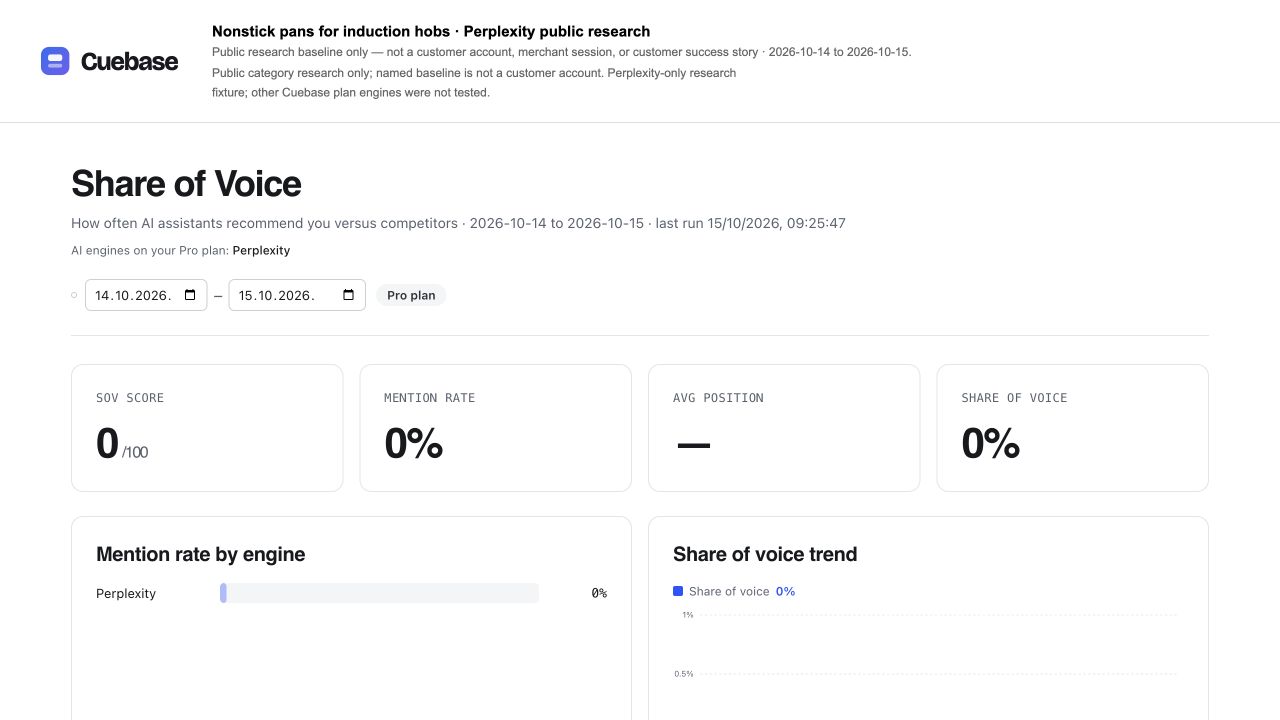
For the report, we tracked Tefal, Ninja, GreenPan, Le Creuset, and Scanpan. Tefal was a research baseline only; no merchant data or customer account was used. The automatic detector found GreenPan in one answer and Le Creuset in one answer. That made each 50% of the two tracked-name appearances. Tefal, Ninja, and Scanpan appeared zero times.
That 50% is not a share of every pan named, a product-quality score, or an overall search rank. It is a share within this fixed five-brand set. The manual reading found 13 positive product proposals, including brands that were never tracked.
Check the claim that matters before you act
The useful finding is where an answer needs product-page proof. We checked the following manufacturer pages on 15 October 2026. Siemens lists HZ9CF280 / 17006185 as induction-suitable with a 22 cm bottom and 28 cm top. That is a clear example of why a nominal pan diameter and the contact base should not be merged.
For another named option, Le Creuset’s UK page gives its selected 28 cm deep pan a 20.4 cm base measurement. Eaziglide lists a 215 mm baseplate for its Neverstick2 28 cm pan. Those are manufacturer-page measurements, not a rule that either pan will suit every hob zone.
Care claims need the same discipline. Kuhn Rikon marks the Easy Induction 24 cm pan dishwasher-safe and also gives hand-wash instructions. That supports “dishwasher-safe” and hand-wash guidance. It does not prove that hand washing is mandatory or that dishwasher use shortens coating life. GreenPan Cambridge was proposed once, but we did not locate a current official Cambridge page; its exact induction and care claims remain unknown here.
Use a repeat mention to choose what to verify: exact model, hob compatibility, upper diameter, contact-base diameter, coating care, and the market-specific product page. Do not copy the answer’s wording into a product description.
Why zero tracked-domain citations did not mean zero sources
The automated tracked-domain citation field was false in all nine saved answers. That field does not say the answer had no sources. The provider placed sources in section-level annotations, which the isolated research harness preserved in a separate log.
Those annotations contained 90 entries, 35 distinct URLs, and 19 hostnames. They are returned source records, not proof that every product claim was right. A normal Cuebase Export CSV exports report metrics; it does not export the raw answer text or a source-by-source annotation record. Keep those materials in a separate research log when you need an editorial review.
Run the same test in Cuebase
Write three fixed questions
In Share of Voice, use a broad shopping question, a requirement question, and a dimension or care question. Keep the wording fixed if you want a later comparison.
Choose a bounded tracked set
Add the brands and domains you actually want to measure. The report will tell you about that set; it cannot rank every product in the market.
Run, export, then inspect
Select Run probe now and use Export CSV for Cuebase’s saved metrics. For a source-level study, retain answer text and returned URLs in a separate research log.
Verify before changing a page
Open the manufacturer’s exact product page. Confirm the feature the shopper asked about, then revise your product content only when your own record supports it.
For the reporting definitions, read AI share of voice and what to count.
Method, limits, and downloads
These were Perplexity sonar responses from the DataForSEO AI Optimization LLM Responses API, run through Cuebase’s real provider and probe workflow with isolated research storage. They were not consumer Perplexity searches. Web search was requested. The output cap was 400 tokens. The UK market was written into each prompt; no provider geolocation was configured.
We tested one engine, nine independent responses, two dates, and a fixed five-brand report set. The study does not measure clicks, orders, demand, quality, or the effect of a catalog edit. A 400-token cap can truncate an answer. It also cannot make a retailer listing or a source annotation into a manufacturer specification.
- Download the prompt-level findings (CSV).
- Download the recommendation checks (CSV).
- Download the nine saved answers, method, and source annotations (JSON).
- Download the source log (CSV).
- Read DataForSEO’s Perplexity response documentation.
Use a Cuebase report to find a claim worth checking, then make the product page carry the proof. See Cuebase’s paid AI visibility tracking →
For your first measurement, use the AI visibility baseline guide.