
“Recycled gym leggings with pockets” asks for several facts at once: fibre content, pockets, length and sometimes price. An AI answer can sound decisive while getting one of those facts wrong. We used Cuebase to separate the names that appeared from the product claims a shopper would still need to check.
The questions and the capture
We ran these three fixed questions through Cuebase's Perplexity provider three times each:
- What recycled gym leggings with pockets would you recommend for women in the United States?
- What full-length recycled gym leggings with pockets would you recommend for women in the United States?
- What recycled gym leggings with pockets under $70 would you recommend for women in the United States?
Six responses were captured on 13 October 2026 and three on 14 October 2026. All nine completed. This is public category research: Girlfriend Collective is a research baseline, and prAna, Patagonia, Athleta and Adidas are fixed comparison names. No customer account or merchant data was used.
What appeared in each question?
| Tracked brand | General | Full length | Under $70 | Total answers naming it |
|---|---|---|---|---|
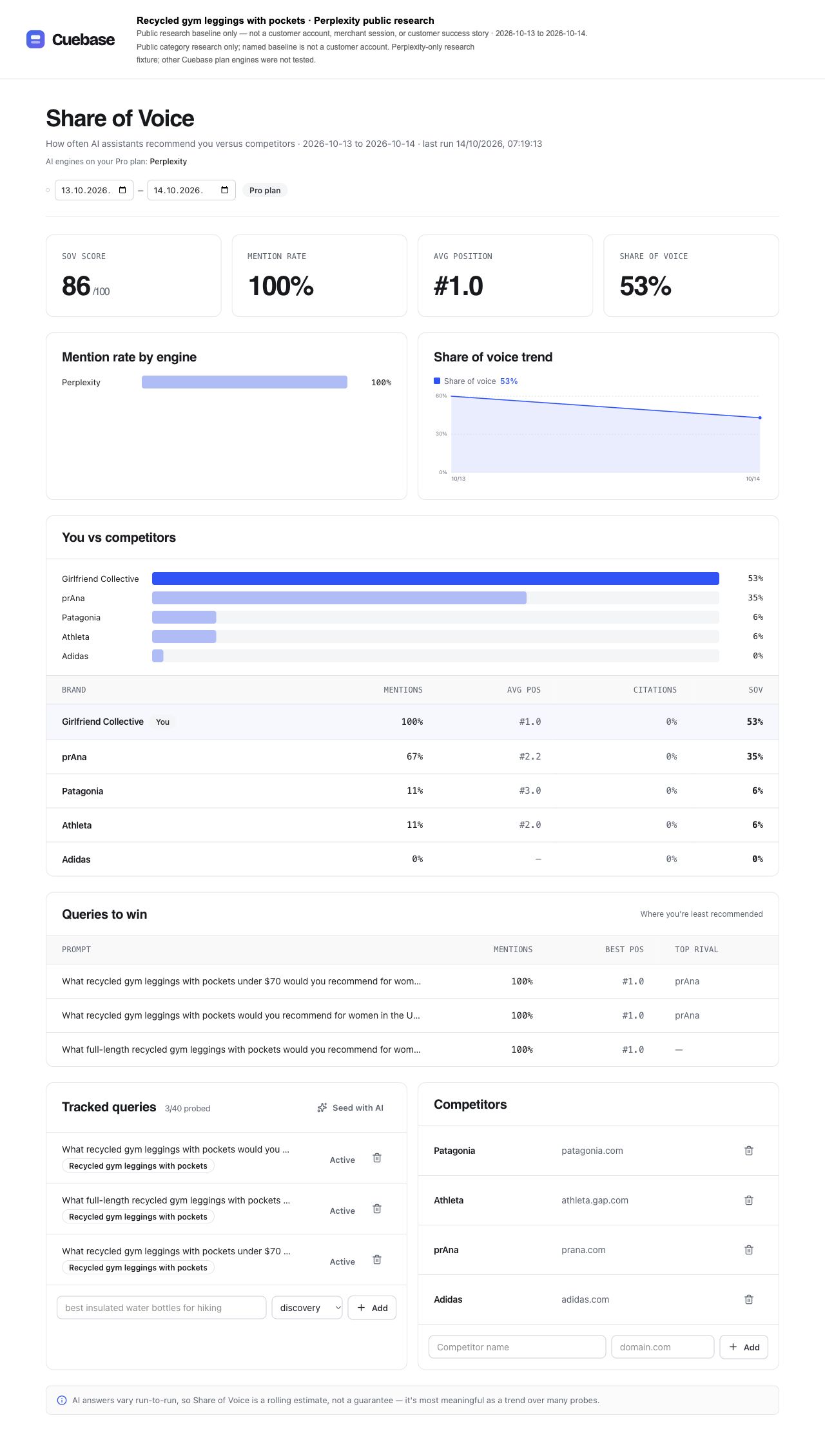
| Girlfriend Collective | 3 of 3 | 3 of 3 | 3 of 3 | 9 of 9 |
| prAna | 3 of 3 | 0 of 3 | 3 of 3 | 6 of 9 |
| Patagonia | 0 of 3 | 0 of 3 | 1 of 3 | 1 of 9 |
| Athleta | 1 of 3 | 0 of 3 | 0 of 3 | 1 of 9 |
| Adidas | 0 of 3 | 0 of 3 | 0 of 3 | 0 of 9 |
We count a tracked name once per answer. The comparison set is deliberately small, so this is not a complete ranking of every product or brand the responses proposed. Other names appeared, including MPG Sport, Adanola, Nike, Rhone, Fabletics, Lululemon and IUGA.
These are mention matches, not a positive-recommendation score. A name can appear with a caveat, and a product named outside the five fixed brands does not affect this table. Girlfriend Collective appeared in every answer. That pattern held across the two dates, but it does not show why the model chose it, predict future answers, or measure clicks or sales.
Mentions and returned sources are different
The responses supplied 90 source annotations: 30 for each prompt. There were 29 distinct URLs across 23 hostnames in the whole capture. The general question repeatedly returned New York Post; the full-length question repeatedly returned DICK'S and Good Housekeeping; the budget question repeatedly returned The Filtery, DICK'S, NBC News, The Good Trade and WIRED.
None of the nine responses had an automated citation match for the tracked baseline domain, girlfriend.com. That does not mean no answer contained useful source material. The provider's automated citation fields can omit annotations attached to sections, so we preserved those section-level sources in the download and reviewed them separately. A source annotation alone is not a recommendation or a direct product link.
Which proposed products passed the required-fact check?
We manually counted a product only when the answer positively proposed it for the shopping task. A brand in a source annotation was not counted. That produced 12 positive product proposals for the general question, 13 for full length and 14 for under $70. That is 39 appearances, not 39 unique products. We counted conditional proposals too, including suggestions to check a sale price or recycled content. Distinct named models from the same brand count separately. The detailed CSV maps every named model to its prompt and check status. Six proposals named the Girlfriend Collective Compressive Pocket model. The checked Black version supports recycled content and side pockets; its dated price did not support the under-$70 claim. This does not verify every colour or size. Four Compressive High-Rise proposals are kept separate because the capture did not identify an exact current Pocket-model page for that name.
A positive proposal is not the same as a full requirement match. Patagonia's Maipo page, checked 14 October, supports recycled nylon and two side pockets but calls the garment 7/8. New Balance's Athletics Heat page, checked 13 October, supports the recycled-polyester fibre claim but did not establish the pocket claim. Lululemon's Wunder Train 28-inch page, checked 14 October, supports full length and pockets, but its main body is nylon and Lycra rather than a recycled-body claim.
The budget answer needs the strictest check. On 13 October, Girlfriend Collective's Black Compressive Pocket Legging page showed $118. prAna's Luxara page showed sale colourways below $70, but the listed checked sizes were sold out. These dated observations do not establish a current under-$70 option for a particular shopper. The exact IUGA model could not be resolved to an official product page from the answer, so its fibre and pocket claims remain unknown.
That is the useful merchant lesson: record the model's wording, then check the exact product, colour, size, price and variant on the manufacturer page before changing a product listing or repeating the claim in copy.
Repeat the research in Cuebase
- Choose three fixed questions. Start with the general shopper question, then add one constraint such as length or price.
- Open Share of Voice. Add the questions and the small set of comparison brands you want to follow. Choose Run probe now.
- Export the saved metrics. Cuebase's Export CSV contains tracked mentions, tracked-domain citations and first appearance among your chosen brands. It does not display or export raw answer text or a product-fact verdict.
- Keep a manual fact log. For a study like this one, the isolated research harness saved answer text and source annotations separately. Check each exact product claim against the manufacturer page, recording the date and variant. A later answer changing does not prove the edit caused it.
Method, limits and downloads
These are DataForSEO AI Optimization LLM Responses API results from Cuebase's Perplexity provider. The returned model was Sonar, web search was requested and each response had a 400-token cap that can truncate an answer. The second full-length response on 13 October ends mid-sentence. The U.S. market was requested in the text; no provider geolocation was configured. These are API responses, not recordings of the consumer Perplexity interface.
Only Perplexity was tested. Nine answers across two dates are a small repeated capture, not a measure of long-term visibility. The study does not measure product quality, availability, conversion, rankings, clicks, sales or the effect of catalog edits. The brand counts use the fixed tracked set, and source annotations may be present even when an automated citation field is empty.
- Download the per-prompt findings (CSV).
- Download the recommendation and fact-check map (CSV).
- Download the nine saved answers, sources and method (JSON). Product statements in the answers are unverified model output unless the fact-check notes say otherwise.
- Read DataForSEO's Perplexity response documentation.